Do Writers Need a Zettelkasten? An Honest Look at Second-Brain Systems
You watched a forty-minute video about someone’s Zettelkasten, admired the little numbered cards and the backlinks lighting up like a subway map, and now it’s Sunday night and you’re three hours into setting up Obsidian instead of writing the short story you sat down to finish. This happens to a specific kind of writer more than any other kind: the one who likes systems almost as much as they like sentences, and who has just discovered that a system can be endlessly, pleasantly tinkered with in a way a blank page cannot.
What a Zettelkasten is actually for
The term comes from Niklas Luhmann, a sociologist who filled roughly ninety thousand index cards over several decades, each one a single idea, cross-referenced by hand to other cards that touched on something related. The point wasn’t storage — a filing cabinet does storage. The point was that new ideas surfaced from the connections between notes he’d written years apart, ones he’d forgotten he’d made. That’s a genuinely powerful tool if your work is synthesizing a large, slow-growing body of research into new arguments. It is a much stranger fit for someone writing a short story, where the material mostly comes from inside one sitting, not from rediscovering a card you wrote in 2019.
Where the system earns its keep
Credit where it’s due: a linked-note system is excellent for specific jobs. If you’re writing nonfiction that draws on dozens of sources, a Zettelkasten-style setup in Obsidian or Roam genuinely helps you notice that the thing you read last week about urban planning rhymes with something you highlighted in a totally different book eight months ago. If you’re world-building a fantasy series with forty characters and a political history spanning three kingdoms, a wiki of linked notes is doing real work keeping you from writing a duke’s eye color two different ways in books two and four. The graph view, the backlinks, the tags-on-tags — none of that is theater in those cases. It’s load-bearing.
Where it quietly becomes a hobby of its own
The trouble starts when the system becomes the project. Tagging a note “#idea/character/motivation” feels like progress — a decision made, a thing filed correctly — but it produced zero new words. Worse, it’s satisfying in a way drafting often isn’t: a tidy graph view gives you a visible payoff a messy first draft never does. A friend of mine kept a gorgeous, color-coded Obsidian vault for a novel she’d been “building” for two years: character sheets, a timeline, forty-one linked notes on worldbuilding rules. The manuscript had eleven thousand words. The system wasn’t helping her write the book. It had become an elaborate way of feeling like she was.
A smaller, honest version
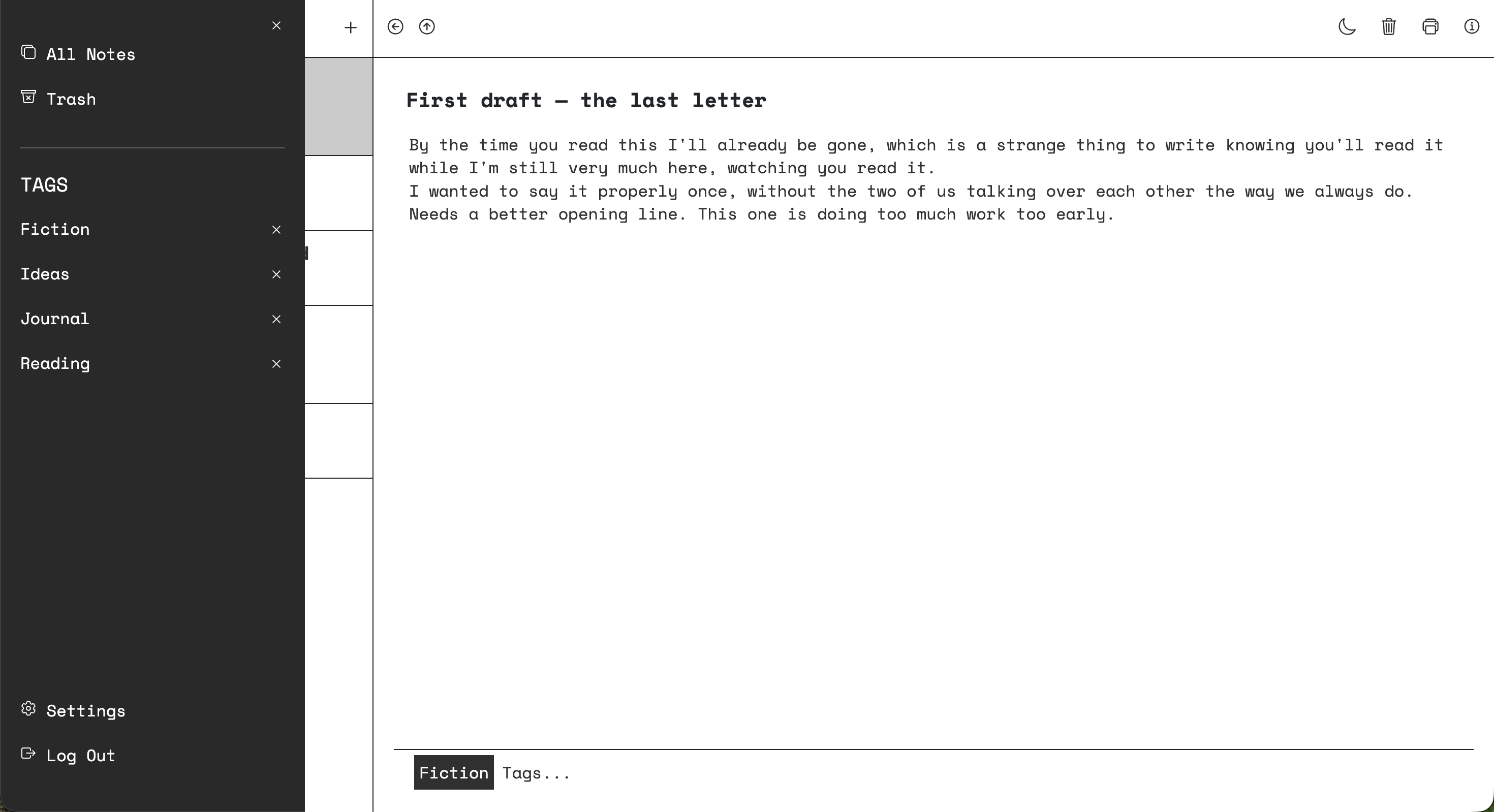
For most short-form or single-project writing — essays, stories, journal entries, a memoir you’re drafting start to finish — the actual information you need to retrieve later is small: a handful of recurring tags, and the ability to search for a phrase you remember writing. That’s it. Typewriter Note is built around exactly that smaller claim: notes get one or two tags, shown in a plain sidebar, and the search bar finds the rest. No backlinks, no graph, no way to embed one note inside another — on purpose. If the character’s eye color question is genuinely a problem you have, this isn’t the tool for it, and no amount of simplicity makes up for the structure a real manuscript wiki provides. But if your actual problem is “I have forty scattered fragments and I can’t remember which note had the opening line I liked,” a tag and a search box solves that in about four seconds, with none of the Sunday-night setup tax.
Test which one you actually need
Before building anything elaborate, try the lazy version for two weeks: one tag per project, nothing cross-referenced, just plain search when you need to find something. If you keep hitting a wall — forgetting connections a backlink would have caught, losing track of a sprawling cast — that’s real signal you need the heavier system, and you should go build it without guilt. If you don’t hit that wall, you’ve just saved yourself from a vault nobody but you will ever read. Try the demo to see what the lazy version feels like day to day, or read how to organize your writing without a complicated system for the wider case against over-engineering a system before you’ve written the thing it’s meant to hold.